
DIAGNOSTIC LABORATORY
Faster answers. Better care. Healthier pets.
At VWP, we truly value every patient we see and know how important it is to get answers quickly when your pet’s health is at stake.
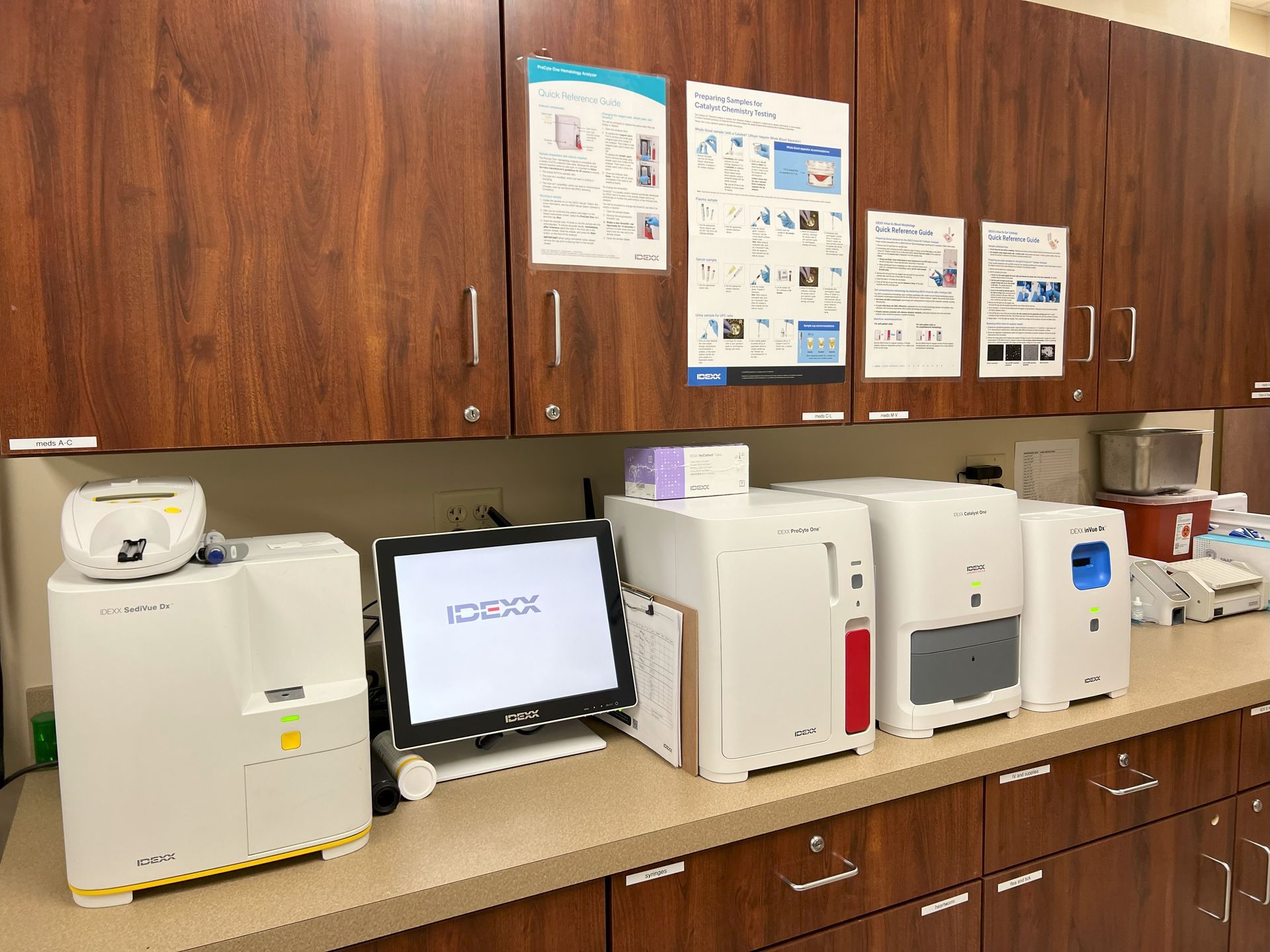
That’s why we continually upgrade our laboratory equipment, including our blood machines, to provide fast and reliable results right here in our clinic.
When additional testing is needed, we also partner with trusted referral laboratories to ensure we never miss a detail.
By combining advanced technology with our compassionate care, we can give you the answers you need sooner—so we can focus on helping your pet or farm animal feel their very best.
In-House Testing
-
Biochemical ProfileList Item 1
A biochemical profile is an essential diagnostic tool, providing a comprehensive overview of an animal's metabolic state and organ function. This panel of tests measures various substances in the blood, including enzymes, proteins, glucose, electrolytes, and other metabolites. The results can help diagnose diseases, monitor ongoing health conditions, and guide treatment decisions.
Key components of a biochemical profile and their significance include:
Liver Enzymes (ALT, AST, ALP, GGT): Elevations can indicate liver damage or dysfunction. Each enzyme has specific considerations regarding the type of liver injury it reflects.
Kidney Function Markers (BUN, Creatinine): These substances are waste products filtered by the kidneys. Elevated levels can indicate reduced kidney function.
Electrolytes (Sodium, Potassium, Chloride, Calcium): Abnormal levels can affect heart function, fluid balance, and muscle activity. They are crucial for diagnosing and managing conditions like dehydration, kidney disease, and endocrine disorders.
Glucose: High levels can indicate diabetes mellitus, while low levels may suggest insulinoma or liver dysfunction.
Total Protein, Albumin, and Globulin: These parameters help assess hydration status, liver function, and immune response. They can also indicate chronic inflammation or infections.
Cholesterol and Triglycerides: Though often associated with diet, abnormalities in these levels can also indicate metabolic and endocrine disorders.
Pancreatic Enzymes (Amylase, Lipase): Elevations in these enzymes can suggest pancreatitis or other pancreatic diseases.
The biochemical profile is often performed alongside a complete blood count (CBC) to provide a more comprehensive view of an animal's health. The process involves collecting a blood sample from the animal, which is then analyzed using specialized laboratory equipment.
-
Thyroxine (T4) Testing
One of the more common tests that we run is the Thyroxine (T4) screening test. This test is a generalized screening for both hypothyroidism (in dogs and horses) and hyperthyroidism (in cats). Oftentimes, the T4 testing is paired with a complete blood cell test and the biochemical profile. These three tests are often considered a baseline screening, especially in senior pets.
A low value on the T4 test usually confirms hypothyroidism. Occasionally we see a low value in debilitated animals. In this case, the low value may be a condition called Euthyroid Sick Syndrome. This is a condition in which the Thyroxine (T4) levels are low due to the other disease process that is ongoing within the pet. Animals with low thyroid levels can be easily supplemented and typical respond favorably to treatment.
A high value is a confirmation of hyperthyroidism. This condition is common in cats. Cats can be treated with medication to counteract the elevated thyroxine levels. There are several methods to treat and each can be discussed with you, should you cat develop overactive thyroid disease.
-
Cytology Write a description for this list item and include information that will interest site visitors. For example, you may want to describe a team member's experience, what makes a product special, or a unique service that you offer.List Item 4
-
Fecal Egg Reduction Test
This is a test that is most often performed in farm animals. The purpose is to measure the worm burden prior to administering a deworming agent and then again following the deworming agent. This allows the tester to monitor the efficacy of the deworming agent that was used. We are also able to identify those animals (usually 10%) that are the high shedders within a herd. Most farm animals will carry a worm burden all of the time due to the presence of worms in their environment, but some carry a larger burden than others. Pastured animals often pick up immature parasite forms from the pasture itself.
A Fecal Egg Reduction test is actually a series of two tests, performed about 6 weeks apart. A fecal sample is obtained. That sample is tested using a three stage process. First 5 grams of the fecal sample is placed into a special test solution and "mixed up." After being mixed, the sample and solution are strained. The strained sample is then placed in a centrifuge for 10 minutes, where it is spun at a high rate. Once the spinning is concluded, a cover slip is place on top of the sample. This allows the eggs to float to the top of the solution and "stick" to the cover slip. After 10 minutes, the sample is viewed through a microscope and an egg count is performed.
-
Intestinal Parasite Testing
At VWP, we are passionate about the care of our animals. Routine care is vital to the health of each and every patient and animal that is entrusted to our care. One part of the routine animal care is the annual fecal, or Intestinal Parasite Test. Many feel that this is an optional test, but it is very important for many reasons, as you will see within this article.
An Intestinal Parasite Test (IPT) is a vital part of the routine care of a dog, cat, horse, goat, sheep or any other animal. In some animals, it is highly recommended to perform serial testing (testing several times over the course of time) of fecal samples. We often called this paired testing a fecal egg reduction test.
Why is it important?
To begin, parasites often cause clinical diseases. These range from general ill-thrift to more debilitating diseases. Ill-thrift may simply show up as an animal that is growing slowly, is lethargic, or simply one that fails to perform well. Some animals, particularly the younger ones, can carry a large enough parasite load to cause death. Many puppies and kittens suffer from the pot-bellied appearance that is caused by this large worm load. Testing is also important considering the fact that some parasites carry a zoonotic risk (They can be contagious to humans).
Can I just Deworm my animal?
While deworming products are readily available, they are limited in their abilities to treat parasites. There are really only three classes of dewormers available and worms can get resistant to each class over time. For this reason, it is important to identify the specific worms that are present in order to treat them effectively.
What is an Intestinal Parasite Test?
The IPT is a test that we perform on a fecal/ stool sample using a microscope to look for the eggs of each different type of worm. This test involves several steps in order to be performed appropriately. The first step is placing the fecal sample into a special solution. This is often a specialized sugar solution that makes the worm eggs easy to detect once the test is completed. The solution is strained to eliminate larger particles and pieces of debris. Once strained, the solution is placed into a centrifuge and spun at a high speed for about 10 minutes. This helps to separate the eggs from the actual fecal matter (poop). Once the spinning is complete, a cover slip, which is a small piece of glass, is placed on the solution. The parasite eggs float to the top and “stick” to the cover slip. The cover slip is placed onto a slide and then looked at under the microscope.
What Worms do you Detect?
An IPT is a great test to detect several parasites, or worms. For dogs and cats these include Roundworms, Hookworms, Whipworms, Tapeworms (though it is not as reliable for tapeworms), and coccidia. In horses, we test for small strongyles (roundworms), large strongyles, bots, pinworms, coccidia and bloodworms. In ruminants (Cattle, Sheep and goats), the IPT detects mainly strongyles and coccidia.
Why Perform a Fecal Egg Reduction Test?
This is a test that is most often performed in farm animals. The purpose is to measure the worm burden prior to administering a deworming agent and then again following the deworming agent. This allows the tester to monitor the efficacy of the deworming agent that was used. Most farm animals will carry a worm burden all of the time due to the presence of worms in their environment. Pastured animals often pick up immature parasite forms from the pasture itself. This test is performed as described above, with typically a 6 week gap in between testing.
We believe that yearly testing for internal parasite is very important in our area of Orrville, Wooster, Rittman, Creston and the surrounding regions of eastern Wayne and western Stark counties. By testing and treating for these worms, we can reduce the build up of parasite eggs and larva within the environment. This is very important when we consider common areas such as the Orrville Dog Park and the Sippo Valley Trail. Please contact us if you have any questions regarding the importance of the IPT or about routine parasite prevention.
In-House Testing
-
Complete Blood Cell Count Write a description for this list item and include information that will interest site visitors. For example, you may want to describe a team member's experience, what makes a product special, or a unique service that you offer.List Item 2
-
Heartworm Testing Write a description for this list item and include information that will interest site visitors. For example, you may want to describe a team member's experience, what makes a product special, or a unique service that you offer.
-
FeLV/FIV Testing
FeLV (Feline Leukemia Virus) and FIV (Feline Immunodeficiency Virus) testing is a critical aspect of feline healthcare, providing essential information about a cat's health status regarding these two serious viral infections. Both viruses affect cats' immune systems, making them more susceptible to other infections and diseases, but they are distinct in their transmission methods and effects on the cat's body.
Purpose of Testing: FeLV/FIV testing is primarily conducted to screen for the presence of these viruses in cats. FeLV is known for causing a variety of health issues, including anemia, lymphoma, and immunosuppression. FIV, often compared to HIV in humans, leads to a weakened immune system by attacking the cat's white blood cells.
Testing Methods:
ELISA (Enzyme-Linked Immunosorbent Assay): This is the most common initial screening tool for both FeLV and FIV. It can be performed in a veterinary clinic and provides rapid results. The test detects FeLV antigen and FIV antibodies in the blood.
IFA (Indirect Fluorescent Antibody Test): Often used to confirm positive ELISA results for FeLV, it detects the presence of the virus in white blood cells, indicating a more advanced stage of infection.
Western Blot: This is typically used to confirm an FIV-positive result from an ELISA test. It's considered the gold standard for FIV diagnosis.
-
CortisolList Item 3
Cortisol diagnostic tests are crucial tools in veterinary medicine for assessing the health and function of the adrenal glands in animals. These tests measure the level of cortisol, a steroid hormone produced by the adrenal cortex, which plays a significant role in stress response, metabolism, immune response, and maintaining blood pressure. Abnormal levels of cortisol can indicate various conditions, including Cushing's disease (hyperadrenocorticism) or Addison's disease (hypoadrenocorticism).
There are several types of cortisol diagnostic tests used in veterinary clinics:
ACTH Stimulation Test: This is the most commonly used test for diagnosing Cushing's disease and can also help identify Addison's disease. It measures how well the adrenal glands respond to the Adrenocorticotropic Hormone (ACTH). The test involves taking a baseline cortisol level, administering synthetic ACTH, and then measuring cortisol levels again after a set period.
Low-Dose Dexamethasone Suppression Test (LDDST): Primarily used for diagnosing Cushing's disease, this test involves administering a low dose of dexamethasone, a synthetic glucocorticoid, to suppress cortisol production. Cortisol levels are measured before and after administration to see if the normal suppression of cortisol production occurs.
High-Dose Dexamethasone Suppression Test (HDDST): Similar to the LDDST but uses a higher dose of dexamethasone. This test can help differentiate between pituitary-dependent Cushing's disease and adrenal tumor-related Cushing's disease.
Urine Cortisol:Creatinine Ratio: This test measures the ratio of cortisol to creatinine in the urine and is used as a screening test for Cushing's disease. It's a non-invasive test that can indicate if further testing is needed.
Each of these tests has its specific indications, benefits, and limitations. The choice of test depends on the suspected condition, the animal's health status, and other diagnostic information. Interpretation of results should be done in the context of the animal's overall clinical picture, as various factors, including stress, illness, and medications, can influence cortisol levels. Collaboration with a veterinary endocrinologist may be beneficial for complex cases.
Our in-house diagnostic laboratory allows us to perform a wide range of tests, including: